Fact Families Blank Templates: A Teacher's Secret for Quick Math Practice
You know that moment at the start of class when you need everyone focused, but you also need a few quiet minutes to take attendance or handle the hundred other things on your list? That's exactly where Fact Families Blank Templates come in. These aren't some complicated resource requiring lengthy instructions or setup time. They're two straightforward, well-designed templates built for one purpose: giving students a quick, structured way to practise number relationships without you standing over their shoulders.
What These Templates Actually Look Like
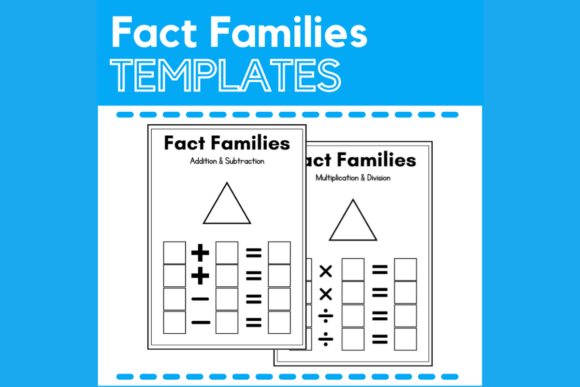
Think clean lines, generous spacing, and a layout that doesn't overwhelm young learners. Each template presents a clear framework where students fill in the related addition and subtraction (or multiplication and division) equations that belong together as a fact family. The visual design prioritises clarity over decoration. There are designated spaces for the three numbers that anchor each family, with lines or boxes prompting students to write out all four related facts.
The appeal here is simplicity. You won't find clip art competing for attention or colours that eat through your printer ink. The templates use a minimalist style that keeps the focus squarely on the mathematics. This kind of restrained design actually works harder than ornate alternatives because students immediately understand what's expected of them. No ambiguity, no "what am I supposed to do here?" moments. Just a clean workspace that invites practice.
Why Morning Work Needs This Kind of Resource
Experienced teachers know that the first ten minutes of class set the tone for everything that follows. Fact Families Blank Templates fit perfectly into that window because they're self-explanatory. Students arrive, see the template on their desk or projected on the board, and get started. There's no lengthy explanation needed, which means you're not repeating instructions while simultaneously greeting latecomers and sorting out lunch orders.
What makes these particularly useful is the blank nature of the templates. Unlike pre-filled worksheets where students simply verify existing equations, blank templates require active recall. Students have to generate the numbers themselves or work from a prompt you've written on the board. That cognitive lift transforms a routine warm-up into genuine learning time. They're not just filling boxes. They're thinking about how three numbers relate to each other across different operations.
Practical Classroom Applications
Morning work is the obvious use case, but these templates stretch further than that. Here are several ways teachers are putting them to work:
- Warm-up exercises before a maths lesson to activate prior knowledge about number relationships
- Exit tickets where students complete one fact family to demonstrate understanding before leaving
- Partner activities where one student writes the three anchor numbers and their partner generates all four equations
- Differentiation tool by choosing whether students work with addition/subtraction families or multiplication/division families based on their level
- Fast finisher activity that keeps early completers productively engaged while others finish their main task
- Assessment snapshots to quickly gauge which students grasp number relationships and which need targeted support
Because you're getting two templates, you can alternate between them to maintain novelty. Students who see the same layout every single day eventually go on autopilot. A slightly different arrangement of boxes or a fresh visual structure resets their attention and keeps the practice feeling intentional rather than repetitive.
Building Fluency Without the Drudgery
Fact fluency is one of those foundational skills that influences everything students do later in mathematics. But drilling facts through timed tests and flashcards can create anxiety, particularly for learners who process information at different speeds. Blank templates offer a different pathway. Students work at their own pace, filling in what they know and thinking through what they don't. There's no timer ticking. No public scoreboard. Just quiet, productive practice.
This approach also reinforces the conceptual understanding behind fact families rather than rote memorisation alone. When students write out all four related equations themselves, they're internalising the relationship between operations. They begin to see that addition and subtraction are inverse operations, that multiplication and division mirror each other. That understanding becomes the foundation for more complex problem-solving later.
Getting the Most From Your Templates
A few practical tips for implementation:
- Print enough copies for a full week and keep them in a designated folder near your morning routine station
- Write a set of three numbers on the board each morning so students know which fact family to work on that day
- Rotate between addition/subtraction and multiplication/division families depending on your curriculum focus
- Use different coloured paper for each template variation to help students quickly identify which one they're using
- Consider laminating a few copies with dry-erase markers for reusable station work
These small adjustments turn a simple printable into a consistent classroom routine that students internalise over time. Within a week or two, they'll walk in, glance at the board, grab their template, and start working without any prompting from you. That's when you know a resource is doing its job.
Efficiency That Actually Matters
Teaching resources earn their place in your toolkit based on one thing: do they save you time while genuinely supporting learning? Fact Families Blank Templates answer that question clearly. They require zero prep beyond printing. They work across multiple grade levels and skill groups. They support independent practice so you can handle the administrative tasks that eat into your instructional time. And they build a critical mathematical skill through repeated, low-stakes exposure.
For the price of a few minutes at the copier, you get a resource that structures your morning routine, reinforces number sense, and frees you up to do the actual teaching that matters. That's a practical win worth keeping in your rotation.