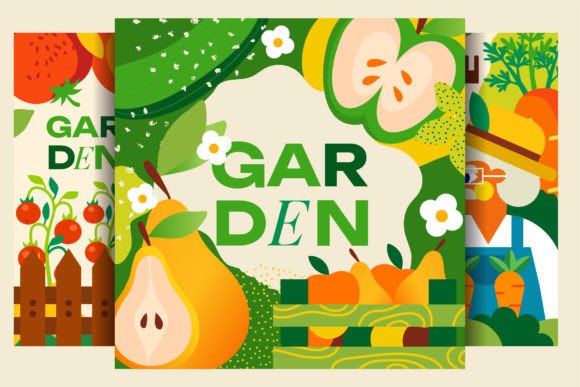
4 Gardening Templates: Cultivating a Fresh Brand Identity
There is a distinct energy in modern agriculture and small-scale farming that feels simultaneously rustic and sleek. It is the blend of earthy roots and contemporary design that defines the "Modern Farmer" aesthetic. If you are a content creator, small business owner, or designer working within the agriculture niche, finding visual assets that capture this balance is often challenging. You need visuals that feel authentic to the soil but polished enough for a high-end farmers market or a trendy organic cafe. This is precisely where the 4 Gardening Templates collection enters the conversation, offering a curated set of vector graphics designed to bridge that gap.
The Visual Language of Modern Gardening
When we talk about the "4 Gardening Templates," we are not just looking at static images of vegetables. We are looking at a specific visual language that prioritizes clean lines, modern composition, and a narrative of abundance. The aesthetic here leans heavily into a contemporary style—think raised garden beds with crisp geometry, bountiful harvests depicted with a sense of organized abundance rather than chaotic mess, and poultry that looks dignified rather than cartoonish. It is a design approach that respects the subject matter while elevating it to a commercial standard.
The personality of these templates is grounded and optimistic. It avoids the overly whimsical look of children’s illustration and the gritty realism of documentary photography. Instead, it occupies a middle ground that is perfect for brand identity work. Whether you are illustrating a blog post about urban farming or creating a label for a new line of organic fertilizer, the visual consistency of these assets helps build a cohesive story. The inclusion of EPS files alongside high-resolution JPGs means the vector scalability is there for large-format printing, such as banners or posters, without losing the sharpness required for digital screens.
Practical Applications for Small Business and Creators
For the entrepreneur or marketer, the utility of the 4 Gardening Templates lies in their versatility across different media types. We often see a disconnect where a brand looks great on Instagram but falls apart on a printed flyer. These templates are designed to function seamlessly across the divide between digital and print.
- Social Media Graphics: The 5000 x 5000 pixel dimensions are significant. In the world of social media, image quality degrades quickly when cropped or resized. Starting with a canvas this large allows you to crop specific sections—perhaps focusing on a single tomato plant or a wheelbarrow—without pixelation. This is essential for creating cohesive Instagram grids or Pinterest pins that drive traffic to your e-commerce store.
- Branding and Packaging: If you run a small farm stand, a CSA (Community Supported Agriculture) box service, or a niche food brand, these assets serve as excellent foundations for packaging design. The modern style pairs well with minimalist typography. You can overlay these images on tote bags, cardboard boxes, or jar labels to create a professional look that justifies a premium price point.
- Flyers and Posters: For local events—like a farm-to-table dinner, a gardening workshop, or a community plant swap—having a high-impact visual is half the battle. The "bountiful harvest" visuals work as a focal point for poster designs, drawing the eye immediately to the theme of the event.
Furthermore, for content creators and bloggers, these templates solve the "stock photo" problem. Generic stock photos often feel sterile. These illustrations have a handcrafted feel that suggests a human touch, which is vital for building trust in the wellness, food, and lifestyle sectors.
Design Strategy and Font Pairing
A visual asset is only as good as the typography that accompanies it. When integrating the 4 Gardening Templates into your editorial design or web design, the choice of typeface is critical. Because the templates feature a modern, somewhat illustrative style, you have a few strategic directions you can take regarding font pairing.
- The Contrast Approach: Pair the detailed imagery with a clean, geometric sans serif font. This creates a modern hierarchy where the image provides the texture and the text provides the clarity. Fonts like Montserrat or Lato work well here to maintain that "Modern Farmer" vibe.
- The Organic Approach: If your brand leans more toward the "homestead" or "artisanal" side, consider pairing the graphics with a script font or a handwritten font. However, exercise caution here; ensure the script is legible at small sizes. The goal is to evoke warmth without sacrificing readability.
- The Editorial Approach: For blog headers or magazine layouts, a sturdy serif font can add a layer of authority. It suggests that the content is well-researched and grounded, much like the agricultural practices it represents.
Remember that these templates act as a backdrop or a supporting element. They should enhance your visual hierarchy, not compete with your message. By keeping your text overlays minimal and using the negative space within the illustrations, you ensure that the audience engages with the content rather than feeling overwhelmed by visual noise.
Evaluating Fit and Licensing for Commercial Projects
Before incorporating any design assets into a client project or your own business, a pragmatic evaluation is necessary. The "4 Gardening Templates" are delivered as EPS files, which is the industry standard for vector work. This format allows for infinite scalability, meaning you can use the same file for a small business card and a large roadside banner. However, you need software capable of handling vector editing, such as Adobe Illustrator or Affinity Designer, to fully utilize the EPS file and customize colors to match your specific brand identity.
When assessing the fit for your project, consider the "personality" of the art. Does the style of the chickens and vegetables match the tone of your brand? If you are marketing a high-tech hydroponic system, the rustic elements might need to be styled carefully to avoid sending mixed signals. Conversely, if you are promoting a heritage seed catalog, the style is likely a perfect match.
From a commercial font and asset perspective, always review the licensing terms. While the prompt specifies these files are for various uses (flyers, branding, etc.), it is good practice to verify if the license covers print-on-demand merchandise if you plan to sell physical goods featuring the art. The inclusion of JPGs at 300 DPI ensures that the print quality will be professional, avoiding the blurry edges often seen in lower-resolution web assets.
Ultimately, the 4 Gardening Templates offer a practical solution for a specific design challenge: making agriculture look contemporary and professional. By leveraging the high-resolution files and pairing them with thoughtful typography, you can build a brand presence that feels both rooted in nature and ready for the marketplace. It is about using these creative font